Quick facts: Washington requirements
- Agency
- Washington State Department of Labor & Industries (L&I)
- Registration
- General or specialty contractor registration
- Required bond
- $30,000 general or $15,000 specialty (continuous surety bond)
Fees, bond amounts, and rules change. Verify every item with the responsible agency before you rely on it.
Somewhere in your research you hit a number that stopped you cold: $30,000. Or maybe it was $15,000. If you assumed you needed to hand over that much cash before you could ever register as a contractor in Washington, take a breath. You do not. That number is the bond amount, not a bill, and mixing up the bond amount with what you actually pay is one of the most common points of confusion for people starting out.
Let's clear it up, because getting this wrong either scares people off before they start or gets them the wrong bond entirely, and both mistakes cost time you do not need to lose.
Ready to see exactly what bond you need and what it will actually cost? Build your free Contractor Lane roadmap and get the real numbers for your trade.
The bond amount is not the premium
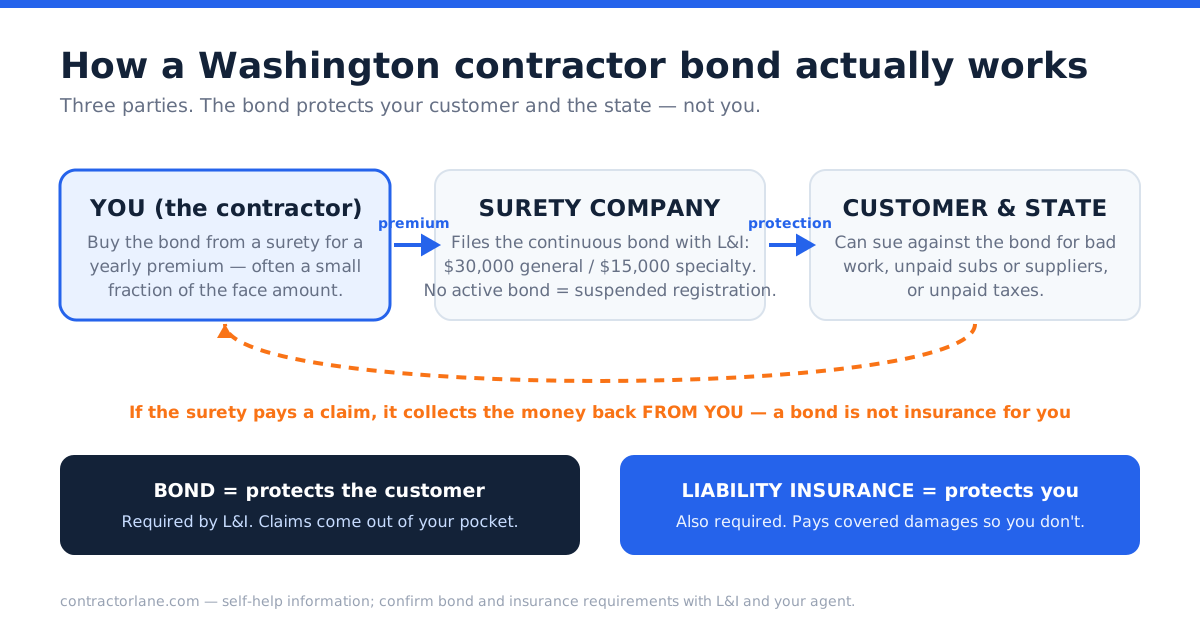
A surety bond is not insurance you buy outright for its full face value. It is a promise, backed by a bonding company, that if you fail to pay a subcontractor, a supplier, or a customer with a legitimate claim, there is money available to make it right, up to that bond amount. Washington sets the amount. You do not choose it and you do not pay it in full up front.
What you actually pay is the premium, a small annual percentage of the bond amount. Your premium depends heavily on your personal credit. Applicants with strong credit tend to land on the lower end, and applicants with weaker credit pay more, but the bond amount itself never changes based on your credit. It is fixed by your contractor type. Confusing the bond amount with the premium is exactly where people either panic and quit or budget wildly wrong before they file a single form.
General contractor: $30,000 bond
If you plan to register as a general contractor, meaning you take on projects that touch multiple trades under one job (a full remodel that involves framing, electrical, plumbing, and finish work, for example), Washington requires a continuous surety bond of $30,000. Continuous means the bond stays in force year over year once it is set up correctly, rather than something you rebuild from scratch every renewal.
Specialty contractor: $15,000 bond
If you plan to work in a single trade, say flooring, painting, drywall, or landscaping, you likely fall under the specialty contractor bond requirement of $15,000. Washington recognizes 63 separate specialty contractor categories, and choosing the correct one matters both for your bond and for what work you are legally allowed to advertise and bid later. Pick the wrong category and you may find yourself unable to take on work you assumed you were covered for.
What actually sets your premium
Bonding companies look at your personal credit because they are the ones exposed if a valid claim comes in against your bond. Strong credit typically earns a lower annual rate. Thinner or rougher credit does not automatically disqualify you, but it usually means a higher premium, and in some cases a bonding company asks for collateral or a co-signer before issuing the bond at all. This is exactly the kind of detail people get blindsided by when they shop for a bond without knowing what they are likely to qualify for first.
The assignment of account alternative
There is another path some contractors use instead of a traditional surety bond: an assignment of account. In simple terms, this means assigning funds held at a financial institution to the state in place of a bond, rather than paying a bonding company's ongoing premium. It is not the right fit for everyone. It comes with its own paperwork and its own tradeoffs, but it exists as an option, particularly for contractors who would rather tie up cash directly than pay a recurring premium, or who are struggling to get approved for a standard bond.
Deciding between a traditional bond and an assignment of account depends on your cash position, your credit picture, and how you want your money working for you. Guessing wrong here wastes real time, and sometimes real money.
Why the bond matters so much
You cannot complete your L&I contractor registration in Washington without proof of your bond already in place, in the correct amount for your contractor type. It is one of the required pieces, alongside your liability insurance, that has to be sorted before the state will register you. Get the bond type wrong, meaning you file as a specialty contractor when your work actually spans multiple trades, or the reverse, and you risk your registration bouncing back, or worse, discovering later that a claim exceeds what your bond actually covers.
Why most people stall out here
This is one of the most common places aspiring contractors get stuck. They see "$30,000 bond" or "$15,000 bond" and assume they need that much money sitting in a bank account, or they call a bonding company cold with no idea which category they should even ask for. Some get quoted a premium that sounds high and give up, not realizing pricing varies a lot between bonding companies and that their own credit picture might qualify them for a better rate elsewhere.
Others get the general versus specialty distinction wrong, buy the wrong bond, and then have to unwind it and start over once L&I flags the mismatch. That is lost weeks, sometimes lost money, on a step that should take a single afternoon once you know what to ask for.
Do not guess your way through bonding. Check in with Contractor Lane and confirm the right bond type and amount for your exact trade before you call a bonding company.
Where Contractor Lane comes in
This is exactly the kind of step where having someone map the path before you spend money matters. Contractor Lane is the front door for starting a contracting business in Washington, built to catch you before you are guessing your way through bonding companies, and before an accounting app or a lead-selling service ever gets a chance to sell you something you did not need yet.
We help you determine whether you fall under general or specialty contractor rules, what your correct bond amount is, and how a bond compares to an assignment of account for your specific situation, all before you commit to either. Once your bond and insurance are correctly lined up, we walk you straight into your L&I registration, and from there into the free roadmap builder so you know what to charge before your first customer ever calls. When you want more hands-on support getting bonded and registered without redoing anything, the paid roadmap is there to guide you the rest of the way.
Ready to launch?
The bond is not the scary number it looks like on the page. It is one piece of a chain, and getting it right the first time keeps you moving instead of circling back. Build your free Contractor Lane roadmap and get the exact bond type, amount, and next step for your trade, in the right order, without the guesswork.
General educational information for people starting a business in Washington. Requirements and fees change. Contractor Lane is not a law firm or tax advisor.