Quick facts: Washington requirements
- Agency
- Washington State Department of Labor & Industries (L&I)
- Registration
- General or specialty contractor registration
- Required bond
- $30,000 general or $15,000 specialty (continuous surety bond)
- Minimum insurance
- $250,000 combined single limit, or $200,000 public liability plus $50,000 property damage
- Application fee
- $150.20 L&I contractor registration application fee (verify current amount)
- Prerequisite
- Unified Business Identifier (UBI) from the Department of Revenue (DOR), required first
Fees, bond amounts, and rules change. Verify every item with the responsible agency before you rely on it.
Short answer: Starting a contracting business in Washington costs roughly $400 in fixed state fees: about $200 for an LLC, $50 for the business license, and L&I registration at $150.20. Bond and insurance premiums are extra, but many contractors get registered for well under $2,000 total, tools included.
Updated October 12, 2026. Requirements and fees change; confirm with the agency named on this page.
Before you commit a single weekend to this, you want a real number. Not a vague "it depends," and not a scary figure some ad threw at you to sell you a bigger package than you need. You want to know what starting a contracting business in Washington actually costs, itemized, so you can decide if now is the right time.
Good news: for most trades, the real number is smaller than people expect. Let's break it down piece by piece.
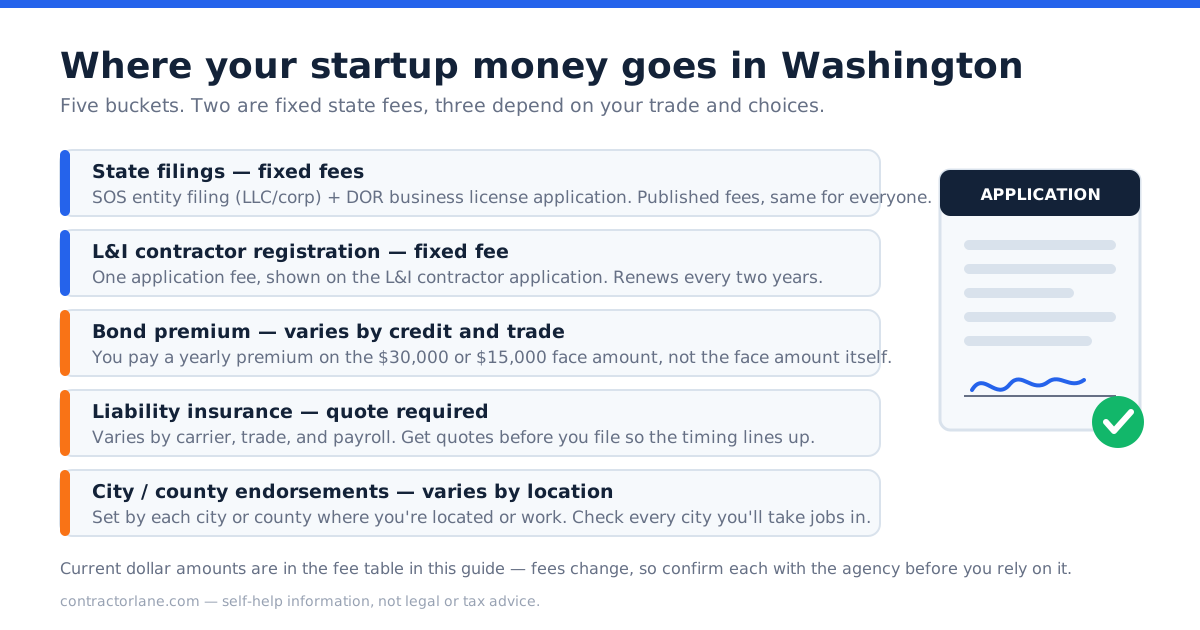
| Cost | Amount | Fixed or varies |
|---|---|---|
| LLC Certificate of Formation (Secretary of State) | $180, plus the online processing fee if filed online | Fixed |
| LLC initial report | No fee if filed with formation; $10 if deferred (due within 120 days) | Fixed |
| State business license and UBI (Business Licensing Service) | $50 for the first location, plus $5 per trade name and any endorsement fees | Fixed |
| L&I contractor registration | $150.20 | Fixed |
| Surety bond ($30,000 general or $15,000 specialty) | Annual premium, a fraction of the bond amount | Varies with credit |
| Liability insurance ($250,000 combined single limit minimum) | Quoted by the carrier | Varies with trade |
Every Washington contractor fee with its official source is in the fees 2026 table.
Want a startup path built around your specific trade instead of a generic checklist? Build your free Contractor Lane roadmap before you spend money.
What each startup cost covers
Forming your LLC: about $200. Filing your Certificate of Formation costs $180, and filing online adds the Secretary of State's online processing fee on top. Either way you also file an initial report: submit it with the formation and there is no separate filing fee, or defer it and it is due within 120 days for $10. Online ends up being both faster and simpler. You do not have to form an LLC to be a contractor, but most people choose to for the personal protection it gives them, and it is one of the first costs you will hit.
State business license: roughly $50. Applying for your Washington State Business License through the Business Licensing Service costs $50 to open the first location of a new business, plus $5 for each trade name you register, plus any state or city endorsement fees, which vary by endorsement. This is also where you get your UBI number, the nine-digit ID that every later step depends on.
Your contractor bond premium: a smaller ongoing cost, not the bond amount itself. People often see "$30,000 bond" for general contractors or "$15,000 bond" for specialty contractors and assume that is the price tag. It is not. That is the coverage amount. What you actually pay is an annual premium, a much smaller percentage of that number, priced based largely on your personal credit.
Liability insurance: a policy meeting the state minimum. Washington requires either $200,000 in public liability plus $50,000 in property damage, or a $250,000 combined single limit. Your actual premium depends on your trade, your coverage limits, and the carrier you choose.
L&I contractor registration fee: $150.20. This is a fixed cost, paid with a notarized application, and it requires your UBI number already in hand before you can file it.
Tools and basic gear. Beyond the state and legal costs, you will need whatever tools your trade requires to actually show up and do the work. This varies enormously by trade. A handyman or painter can often get moving with tools they may already own or can pick up secondhand. A trade like flooring or concrete may require more investment up front.
How much does it cost in total?
Stack the fixed state costs together, the LLC filing, the business license, and the L&I registration fee, and you are looking at roughly $400 before insurance and bonding premiums even enter the picture. Add a modest bond premium and a basic insurance policy, both of which vary by credit and trade, and many aspiring contractors find they can get fully registered and legally able to bid work for well under $2,000 total, tools included, if they already own some basic equipment.
That number surprises people. Contracting has a reputation as an expensive business to start, and it can be, if you are buying a fleet of vehicles and a warehouse of specialty equipment on day one. But the actual legal path to becoming a registered contractor in Washington is one of the more affordable ways to start a small business, especially compared to the ongoing lead-buying costs contractors get pitched later once they are already registered and searching for their first jobs.
What is not on this list
This breakdown covers what it costs to legally exist as a registered contractor. It does not cover a vehicle if you do not already have one suited for the work, a website if you decide to build a fancier one than you strictly need, or your first few months of living expenses while you build up a client base. Those are real costs too, and worth planning for separately, but they are not requirements to register, and they should not be confused with the actual legal startup cost.
Why do people get the startup cost wrong?
People tend to land in one of two traps. Some overestimate wildly, hearing "$30,000 bond" and assuming they need that in cash before they can even apply, and they talk themselves out of starting entirely over a number that was never actually a bill. Others underestimate, assuming the state business license and L&I fee are the only costs, and then get surprised by an insurance premium or a bond premium they had not budgeted for, sometimes discovering the real number only after they have already started the paperwork.
Both mistakes come from the same root problem: nobody laid out the real, itemized list ahead of time, in order, so people had an accurate total before they started spending.
Do not start spending before you know your real number. Check in with Contractor Lane and get a cost breakdown built around your specific trade and situation.
Where Contractor Lane comes in
Knowing the rough total is useful. Knowing your specific total, based on your trade, your credit, and whether you already own tools, is what actually lets you plan. Contractor Lane is the front door for starting a contracting business in Washington, and we exist to catch you here, before you either talk yourself out of starting over a misunderstood number or get blindsided by a cost nobody warned you about.
We walk you through each cost in the order you will usually face it, flag which numbers are fixed and which vary, and explain why bond and insurance premiums can change by trade and applicant. Once you are registered, the roadmap keeps the next setup steps in order: Google, website, payment setup, basic books, and first-job outreach. If you want guided help building your launch budget, the paid Startup Roadmap walks you through it.
The real cost of starting a contracting business in Washington is smaller than the scary number that stopped you from Googling this in the first place. Build your free Contractor Lane roadmap and get the startup sequence around your actual trade before you spend a dollar.
Get told when a Washington rule on this page changes
Washington fees and contractor rules change, often on July 1 and January 1. Leave your email and Andy will email you when a fee or rule in these guides changes. Nothing is sent automatically, and you can ask us to stop at any time.
We do not sell your information. See our Privacy Policy.
Common questions
Do I have to pay the full $30,000 bond amount to register as a contractor?
No. The $30,000 general or $15,000 specialty figure is the coverage amount, not the price. What you actually pay is an annual premium, a much smaller percentage of that number, priced largely on your personal credit.
How much is the L&I contractor registration fee?
The L&I contractor registration application fee is $150.20, paid with a notarized application. You need your UBI number in hand before you can file it. Fees change, so verify the current amount with L&I.
Do I need an LLC to start a contracting business in Washington?
No. You do not have to form an LLC to be a contractor, but most people choose to for the personal protection it gives them. Filing the Certificate of Formation costs $180, and filing online adds the Secretary of State's online processing fee.
General educational information for people starting a business in Washington. Requirements and fees change. Contractor Lane is not a law firm or tax advisor.
Get covered
Need general liability insurance to register?
Washington won't approve your contractor registration without proof of liability coverage. Hiscox writes small-business and trade policies you can quote and buy online in a few minutes.
Get a free insurance quote → Affiliate link: if you buy a policy through Hiscox, Contractor Lane may earn a commission at no additional cost to you. We only point to coverage a contractor actually needs. Always compare quotes and confirm the policy meets Washington's minimums before you buy.Already running jobs?
Then Operator takes it from here.
A business audit and a plan, an online mentor you can ask any time, team training for your crew, and deadline reminders. $79/month, any state, cancel anytime.
Official sources
Every requirement on this page comes from the agency or statute below. Fees and rules change; confirm with the source before you rely on a figure.