Quick facts: Washington requirements
- Agency
- Washington State Department of Labor & Industries (L&I)
- Registration
- General or specialty contractor registration
- Required bond
- $30,000 general or $15,000 specialty (continuous surety bond)
- Application fee
- $150.20 L&I contractor registration application fee (verify current amount)
- Prerequisite
- Unified Business Identifier (UBI) from the Department of Revenue (DOR), required first
- Also required
- Separate L&I electrical contractor license
Fees, bond amounts, and rules change. Verify every item with the responsible agency before you rely on it.
Short answer: Washington calls it contractor registration, not a license, and you get it from L&I. Get a UBI from the Department of Revenue first, then file a notarized application with the $150.20 fee, carry a $30,000 general or $15,000 specialty bond, and show proof of liability insurance.
Updated October 12, 2026. Requirements and fees change; confirm with the agency named on this page.
Want your exact path? Answer five questions and build the free Washington startup roadmap. It puts UBI, L&I registration, bond, insurance and trade licenses in the order that applies to you.
If you have been searching for how to get a "contractor license" in Washington, here is the first thing worth knowing: Washington does not call it a license in the way some states do. What you actually need is active contractor registration through the Department of Labor & Industries, commonly called L&I, and it comes with its own bond, insurance, fee, and application requirements that all have to line up before L&I will approve you.
That is genuinely good news. It means the path is well-defined. The catch is that it is a sequence, not a single form, and getting the pieces in the wrong order is exactly what stalls most new contractors for weeks at a time.
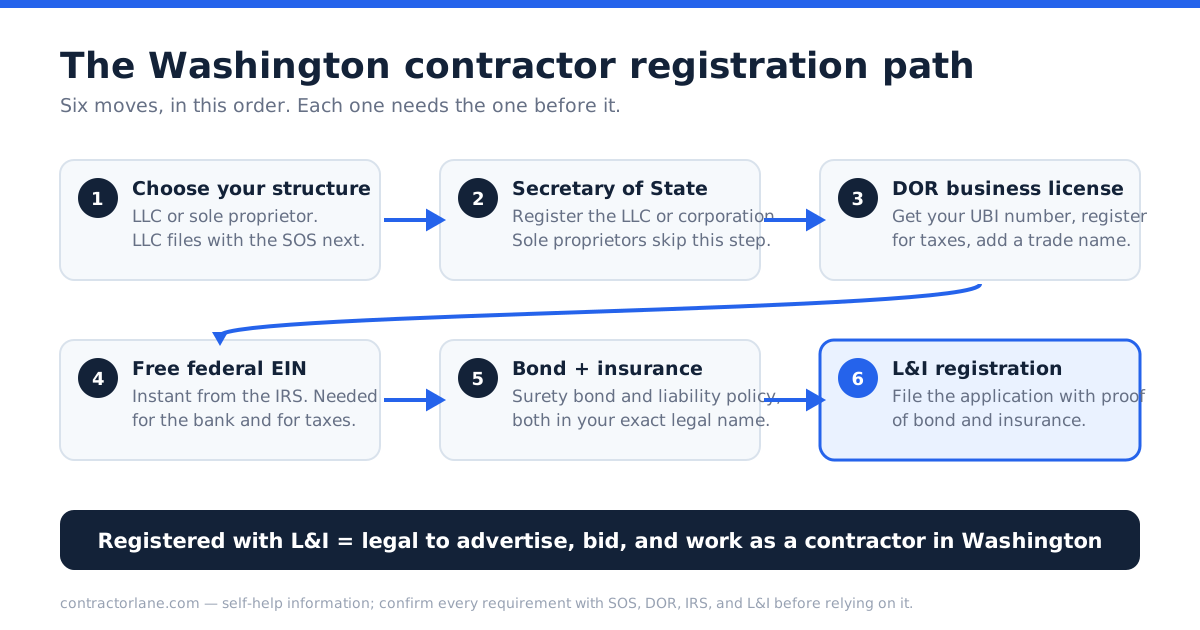
Want your specific licensing path instead of guessing at the order? Build your free Contractor Lane roadmap and see it mapped to your trade.
How to get a contractor license in Washington, step by step
Step 1: Get your UBI number first
Before L&I will even look at your application, you need a Unified Business Identifier, the nine-digit number Washington issues when you file your state business license. Every subsequent filing references this number, so trying to register with L&I before it exists is the single most common way people waste time on this process.
Step 2: Confirm your trade category
Washington recognizes 63 specialty contractor categories in addition to general contractor status. Not every category has the same requirements. Electrical work needs a separate L&I electrical contractor license on top of registration, along with certified electricians. Plumbing work requires certified plumbers. Most other specialty trades ride mostly on the contractor registration itself, without a separate trade exam layered on top. Knowing exactly which category your work falls under, and whether it needs anything beyond the base registration, matters before you assume you are finished.
Step 3: Get the right contractor bond
L&I requires a continuous surety bond on file before registering you. A general contractor, meaning one who takes on work across multiple trades on a project, needs a $30,000 bond. A specialty contractor, meaning one working a single trade, needs a $15,000 bond. This is where most confusion happens: that bond number is the coverage amount the bond guarantees, not what you pay for it. Your actual annual premium is a much smaller figure, priced against your credit history, and in some cases an assignment of account can substitute for the bond entirely. Buying the wrong bond amount for your trade, or misunderstanding the premium versus the coverage, is a common and avoidable delay.
Step 4: Buy liability insurance at the state minimum
Washington sets a minimum of $200,000 in public liability coverage plus $50,000 in property damage coverage, or alternatively a combined single limit of $250,000. You need proof of this insurance in hand at the point of registration, matched to the correct limits, not a policy you plan to upgrade later. Buy short on the limits and your application will not clear.
Step 5: File the notarized L&I application
This is the core filing. It requires a notarized application and a fee of $150.20. Notarization trips people up more than you would expect, since it means you cannot just fill out a form online and submit it in five minutes. Plan for the extra step, and do not submit until your UBI is active, or the application gets sent back.
Putting it all together. Current fees for every step are in the Washington contractor fees 2026 table. Once your UBI exists, your bond is active at the right amount for your trade, your insurance meets the minimums, and your notarized application with the $150.20 fee is submitted correctly, L&I approves your registration. Registration is what lets you advertise and bid construction work in Washington; you may still need a city business license where you work, and plumbing, electrical and some other trades also need the separate trade license or certificate.
Taxes sit quietly underneath all of this. Washington has no personal income tax, but every business pays a Business and Occupation tax on gross receipts, and that obligation starts the moment you are operating, licensed or not. It is worth understanding this early rather than discovering it at tax time, since it affects how you price jobs and set aside money from the very first check you cash. If you plan to bring on employees later, remember that hiring triggers L&I workers' compensation, unemployment insurance, and Paid Family and Medical Leave obligations on top of your own registration, so growth changes your compliance picture too.
Why do Washington contractor applications get sent back?
Almost nobody gets tripped up by any single requirement here. What actually stalls people is sequencing and small mismatches. Applying to L&I before the UBI is active. Buying a $15,000 specialty bond when the work actually spans multiple trades and needs the $30,000 general contractor bond. Carrying insurance at limits just under what the state requires. Forgetting the notarization step and having the whole application sent back.
Each mistake individually costs a week or two of delay while you fix it and resubmit. Stack two or three of them together, which happens more often than you would think, and a process that should take a couple of weeks stretches into a couple of months. That gap is exactly where motivated people lose momentum and quietly go back to working for someone else.
Do not let a bond mismatch or a missing notarization cost you three weeks. Contractor Lane maps your exact path, free to start.
Once you are registered, your record is public. Customers, and general contractors who hire you, will check it on L&I's free lookup before they trust you with a job, so it is worth knowing what they see: here is how to look up and verify a Washington contractor license, including your own.
Where Contractor Lane comes in
Contractor Lane is built to be the front door for people getting registered as a contractor in Washington, reaching you before the accounting apps and the lead-selling platforms do. We map the entire registration path to your specific trade, so you know exactly which bond amount you need, exactly which insurance limits apply, and exactly what order to file everything in so nothing bounces back.
From the day you start, you also get the free roadmap builder. If you want more hands-on support turning your fresh registration into steady work, the paid Startup Roadmap gives you the deeper guided setup when you are ready.
Getting registered in Washington is straightforward once you have the order right, and expensive in lost time when you do not. Build your free Contractor Lane roadmap and get your first-pass contractor registration path, matched to your trade, with the bond, insurance, and application requirements laid out in the right sequence, plus the startup roadmap tools from day one. Get started today and register once, the right way.
Get told when a Washington rule on this page changes
Washington fees and contractor rules change, often on July 1 and January 1. Leave your email and Andy will email you when a fee or rule in these guides changes. Nothing is sent automatically, and you can ask us to stop at any time.
We do not sell your information. See our Privacy Policy.
Common follow-up questions: Is there an exam? · Licensed in another state? · What if L&I denies or suspends you? · Do you need a city license too?
Common questions
Do I need a UBI number before I apply to L&I?
Yes. The UBI is the nine-digit number issued when you file your state business license, and trying to register with L&I before it exists is the most common way people waste time. Do not submit until your UBI is active, or the application gets sent back.
How much liability insurance do I need to register as a contractor in Washington?
The minimum is $200,000 public liability plus $50,000 property damage, or a combined single limit of $250,000. You need proof of that coverage at the point of registration, matched to the correct limits, not a policy you plan to upgrade later.
Do I need a separate license for electrical or plumbing work in Washington?
Electrical work needs a separate L&I electrical contractor license on top of registration, along with certified electricians. Plumbing work requires certified plumbers. Most other specialty trades rely mostly on the contractor registration itself, so confirm your category with L&I.
General educational information for people starting a business in Washington. Requirements and fees change. Contractor Lane is not a law firm or tax advisor.
Get covered
Need general liability insurance to register?
Washington won't approve your contractor registration without proof of liability coverage. Hiscox writes small-business and trade policies you can quote and buy online in a few minutes.
Get a free insurance quote → Affiliate link: if you buy a policy through Hiscox, Contractor Lane may earn a commission at no additional cost to you. We only point to coverage a contractor actually needs. Always compare quotes and confirm the policy meets Washington's minimums before you buy.Already running jobs?
Then Operator takes it from here.
A business audit and a plan, an online mentor you can ask any time, team training for your crew, and deadline reminders. $79/month, any state, cancel anytime.
Official sources
Every requirement on this page comes from the agency or statute below. Fees and rules change; confirm with the source before you rely on a figure.
- L&I: Register as a contractor
- L&I form F625-001-000, contractor registration application
- RCW 18.27.020, registration required
- RCW 18.27.040, contractor bond
- RCW 18.27.050, insurance or financial responsibility
- WAC 296-200A-016, specialty contractor classifications
- WAC 296-200A-900, contractor registration fees
- Department of Revenue: business licensing and renewals
- L&I Verify, look up a contractor