Quick facts: Washington requirements
- Agency
- Washington State Department of Labor & Industries (L&I)
- Registration
- General or specialty contractor registration
- Required bond
- $30,000 general or $15,000 specialty (continuous surety bond)
- The rule
- One trade: specialty. Two or more trades: general (L&I F625-001)
- Exception
- Handyman specialty (26): solo, under $2,000 per job, no permit work
- Separate licenses
- Plumbing (18.106 RCW, $6,000 bond) and electrical (19.28 RCW, $4,000 bond)
Fees, bond amounts, and rules change. Verify every item with the responsible agency before you rely on it.
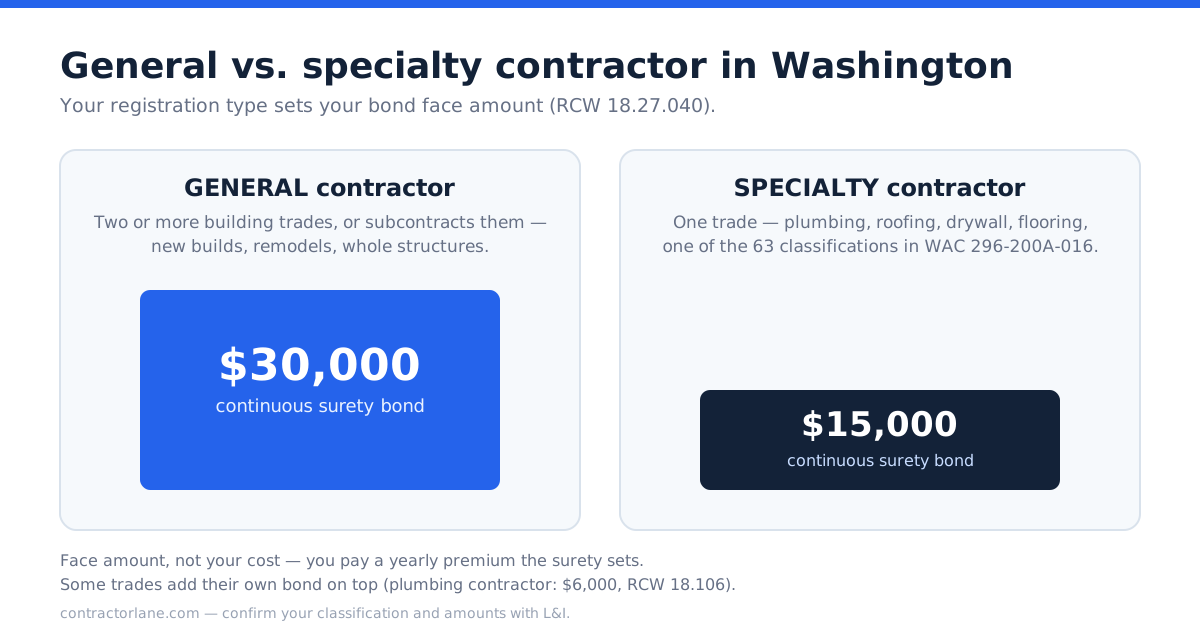
Washington draws this line with one rule, and L&I prints it on its own contractor registration application (F625-001): a general contractor "may perform more than one construction trade," and a specialty contractor "may only perform the trade selected." The form has a single box for the specialty trade. So the practical test is simple: if you will offer one trade, you register specialty with a $15,000 bond. If you will offer two or more trades, even on separate jobs, you register general with a $30,000 bond. The one exception is the handyman specialty, covered below.
What the law says
RCW 18.27.010 defines a general contractor as one "whose business operations require the use of more than one building trade or craft upon a single job or project or under a single building permit." A specialty contractor is everyone else, and a specialty contractor "may only subcontract work that is incidental to the specialty contractor's work." The bond amounts come from RCW 18.27.040: $30,000 for general and $15,000 for specialty. L&I applies the rule through the registration itself: you pick one specialty trade, and that is the trade you are registered to perform.
Quick examples
- Painting only: specialty, painting and wall covering (40). $15,000 bond.
- Roofing only: specialty, roofing (44). $15,000 bond.
- Roofing and drain cleaning: two classifications, (44) and (13), so general. $30,000 bond.
- Drywall and painting: two classifications, (15) and (40), so general. $30,000 bond.
- Kitchen and bath remodels: several trades on one job, so general. $30,000 bond.
- Solo handyman doing small home repairs under $2,000, no permits: handyman specialty (26), even across several trades. $15,000 bond.
The handyman exception
WAC 296-200A-016(26) creates a handyman specialty that is allowed to cross trades, with tight limits. The contractor "must be an individual who does all work personally without employees or other specialty contractors." A handyman "may perform more than one unrelated specialty trade or craft provided they do all work themselves," but all work is limited to "minor and casual work of existing residential maintenance and repair with a total dollar value of time and materials under two thousand dollars," and "work requiring a building permit may not be done by this specialty." An LLC or corporation can hold it if one person is identified as the handyman. The moment you hire an employee, use a subcontractor, take a job of $2,000 or more, or need a permit, you have outgrown it and need the general registration. Handyman work can still require plumber certification or an electrical license for those parts of a job. Full detail is in do you need a license for handyman work in Washington.
Trades that need a separate license
Plumbing runs under its own plumbing contractor license (chapter 18.106 RCW): a $6,000 bond, $250,000 in liability insurance, and a designated certified plumber. L&I says plumbing contractors who also do non-plumbing construction work can also register as a general or specialty contractor, with a separate bond. Electrical runs under its own electrical contractor license (RCW 19.28.041): a $4,000 bond and an assigned electrical administrator or master electrician. L&I notes that if an electrical contracting business also does non-electrical work, contractor registration may also be required. HVAC/R is a regular specialty (28), but the work "may also require" an electrical license and plumber certification. L&I also lists extra licensing for elevator, manufactured or mobile home installation, boiler, and asbestos work.
All 63 specialty classifications
These are the 63 specialty classifications in WAC 296-200A-016. Each one has its own scope definition in the rule, so read yours before you register.
- Appliances, equipment
- Asbestos and lead
- Awnings, canopies, patio covers and exterior screens
- Boiler, steam fitting, process piping
- Cabinets, millwork and finish carpentry
- Central vacuum systems
- Closets
- Commercial/industrial refrigeration
- Concrete
- Construction clean-up
- Demolitions and salvage
- Doors, gates and activating devices
- Drain cleaning and snaking
- Drilling, blasting and soil sampling
- Drywall
- Electrical (see chapter 19.28 RCW)
- Elevator
- Excavation, grading and land clearing
- Fencing
- Fireproofing and coating
- Fire protection
- Floor covering and counter tops
- Framing and rough carpentry
- Glass and glazing
- Gutters and downspouts
- Handyman
- House moving
- Heating, ventilation, air-conditioning and refrigeration (HVAC/R)
- Industrial equipment/machines
- Institutional equipment, stationary furniture, lab tables, lockers
- Insulation and acoustical
- Irrigation sprinkler systems
- Landscaping
- Lathing and plastering
- Locks, security alarms and warning systems
- Masonry
- Manufactured/mobile home set up
- Metal fabrication/sheet metal
- Overhead/garage doors
- Painting and wall covering
- Paving/striping/seal coating
- Plumbing (plumber certification required)
- Pressure washing
- Roofing
- Sandblasting
- Sanitation systems and/or side sewers
- Scaffolding and safety railings
- Service station equipment and maintenance
- Siding
- Signs
- Steel erectors
- Structural pest control
- Suspended ceilings and acoustical tile
- Swimming pools, spas and hot tubs
- Tanks and tank removal
- Tile, ceramic, mosaic and natural and manufactured stone
- Tree removal
- Utilities and telecommunications
- Window coverings
- Water conditioning equipment
- Welding and ornamental metal
- Well drilling
- Wood/pellet and gas stove
What it costs either way
Both registrations use the same application and the same $150.20 fee, the same general liability minimum ($200,000 public liability and $50,000 property damage, or $250,000 combined single limit), and a UBI from the Department of Revenue. The difference is the bond: $30,000 general or $15,000 specialty. You pay an annual premium on that bond, not the face amount.
Common mistakes
- Registering one specialty and doing a second trade. A specialty registration covers the trade selected. Doing another trade means working outside your registration.
- Registering general "just in case." If you really do one trade, that doubles your bond for no reason.
- Treating the handyman specialty as a small general license. It is solo only, under $2,000 per job, existing homes only, and no permit work.
- Assuming plumbing or electrical are just specialty boxes. They need their own license, bond, and certified people.
Still not sure?
Ask L&I directly at [email protected] or 1-800-647-0982 and describe the exact work you plan to do. Or answer a few questions in the free roadmap builder and it will lay out your registration path in order.
Get told when a Washington rule on this page changes
Washington fees and contractor rules change, often on July 1 and January 1. Leave your email and Andy will email you when a fee or rule in these guides changes. Nothing is sent automatically, and you can ask us to stop at any time.
We do not sell your information. See our Privacy Policy.
General educational information for people starting a business in Washington. Requirements and fees change. Contractor Lane is not a law firm or tax advisor.
Get covered
Need general liability insurance to register?
Washington won't approve your contractor registration without proof of liability coverage. Hiscox writes small-business and trade policies you can quote and buy online in a few minutes.
Get a free insurance quote → Affiliate link: if you buy a policy through Hiscox, Contractor Lane may earn a commission at no additional cost to you. We only point to coverage a contractor actually needs. Always compare quotes and confirm the policy meets Washington's minimums before you buy.Already running jobs?
Then Operator takes it from here.
A business audit and a plan, an online mentor you can ask any time, team training for your crew, and deadline reminders. $79/month, any state, cancel anytime.